On the occasion of his first meeting with a Breton community, Bishop Elisey of Reutov was glad to return to places dear to him from his youth.
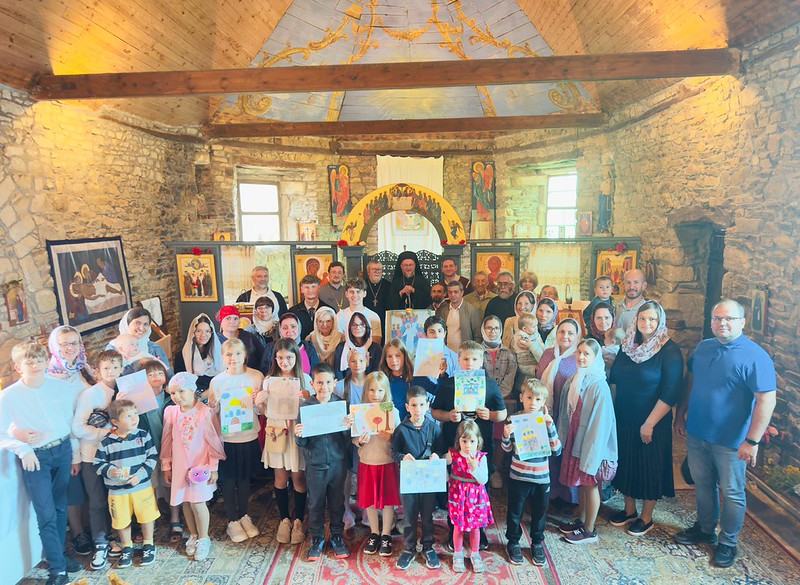
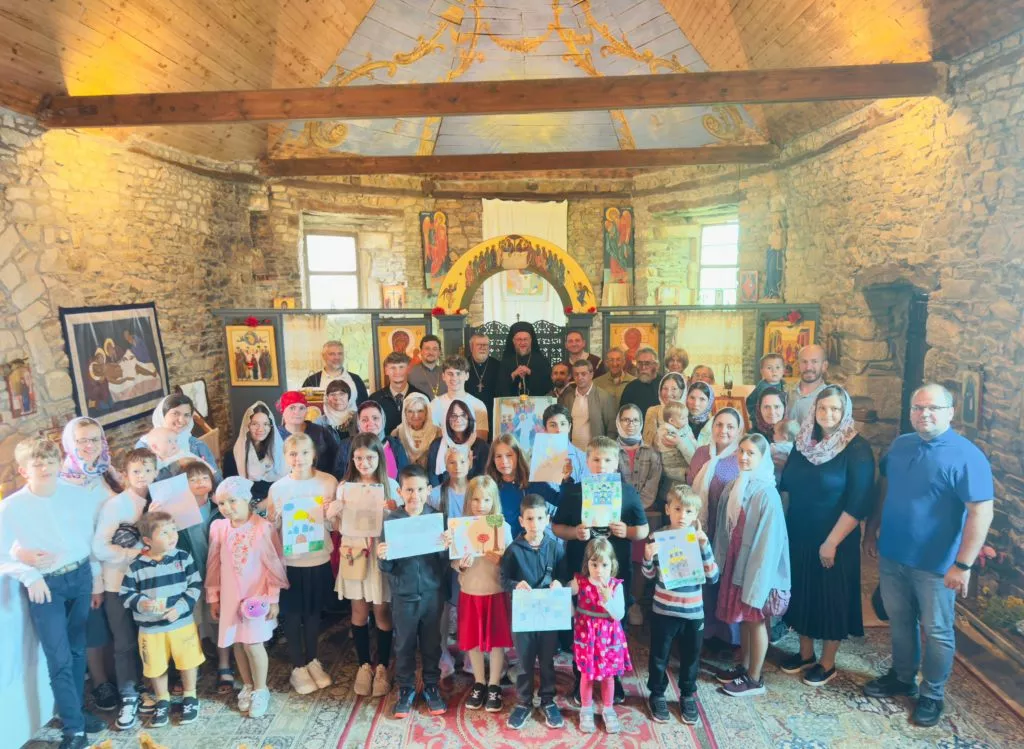
After visiting the rector of the parish, Father Jean-Michel Sonnier, who was unable to be present at the gathering on account of his health, Bishop Elisey, accompanied by Ionut, as discreet as he is efficient when the bishop travels, went on Sunday morning to the Chapel of the Holy Spirit, at the place called Le Sépulcre, in Plérin.
There he presided at the concelebrated Liturgy of the 13th Sunday after Pentecost, with the commemoration of the holy Apostles Bartholomew and Titus, together with Fathers Alain, the second priest of the parish, and Mihaïl and Alexi, Ukrainian priests who are refugees in Brittany, driven from their country by the war, and who have been welcomed with their families into the community.
The readings, like the chants, alternated between French and Slavonic, thanks to the efforts of the readers Alexis, Adrian and Pavel and the choir directors Denise and Natalia, the congregation being made up of parishioners of diverse origins. Thus the Lord’s Prayer was recited in French, Georgian, Romanian and Slavonic.
Following the reading of the Epistle (1 Cor. 16:13-24), the conclusion of the 1st Epistle to the Corinthians in which Saint Paul insists once again on fraternal love (“Let all that you do be done in love!”), the Gospel (Matt. 21:33-42: the parable of the master of the house who planted a vineyard) and Bishop Elisey’s reflection on it were a renewed invitation to consider the importance of Christian love. First, the love of the Father for His Vineyard, that is, for the whole of Creation, of which we are all the workers, and which means that, out of filial gratitude, we ought to “render love for love.” But the parable shows that this is far from being the case: “sinful man, shut up in fear (Gen. 3:10), prefers the distant, indifferent God of deism, or some other impersonal divinity, to the God who is near in the Judaeo-Christian Revelation, whom he finds too “cumbersome.” And this goes as far as the murder of the very Son whom the owner sends into his Vineyard.”
Drawing a greater good from the very malice of men, the Father, through “the Passion of Christ’s love for us,” reveals His mercy once again and invites us in turn to set out on the path of love. Bishop Elisey concluded: “It is by exposing ourselves to this divine love that shines forth from the glorious Cross of our Saviour that our hearts of stone will melt and that we shall become capable of loving in our turn, “at last causing the Lord’s vineyard to bear its fruit.””
At the end of the service, Father Alain thanked Bishop Elisey for all the simplicity and authenticity that his presence in the community had shown.
A fraternal meal, held in the parish hall kindly lent by the Catholic community of Pordic, near Plérin, allowed the “sacrament of the altar” to be prolonged by the “sacrament of the brother,” and gave the bishop the opportunity to meet several members of the parish, conversations taking place in French as well as in Russian and Ukrainian. Before returning to the Monastery of Saint Silouan, of which he is the hegumen, Bishop Elisey was thus able to speak with several young people who are making their way towards the Church.