Dear Friends,
To enter more fully into Great Lent, we offer you this reflection and recommend reading the excellent book by Hieromonk Macarius of the Holy Monastery of Simonopetra “Mystagogy of Great Lent – An Essay on the Theology of Liturgical Time”.
Meatfare Sunday: the Last Judgment
This Sunday is called “Meatfare Sunday” because in the week that follows, a limited fast, that of abstinence from meat, is prescribed by the Church. On the other hand, the abstinence from dairy products that we all keep on Wednesdays and Fridays throughout the year is lifted during the following week, called Cheesefare Week. It is gradually that the Church, who knows our frailty and our spiritual weakness, introduces us to the effort of fasting.
The Gospel of the day speaks of the Last Judgment and makes us attentive to the most important criterion of God’s judgment: love. The Lord teaches us to see Christ in every human being, and to love our neighbour as He Himself loves us, with an eternal and personal love.
Saturday of the Holy Ascetics
On this day we commemorate all those, men and women, who have been illumined by fasting, the saints who are our models and our guides in the difficult art of fasting and repentance.
The Vespers of this day are very important: they introduce us to the theme of the last Sunday before Lent: forgiveness.
Forgiveness Sunday, or the Sunday of the Expulsion of Adam from the Paradise of Delight
Lent begins in earnest with the Vespers of this Sunday. With Adam, we were deprived of the Paradise of delight and of the blessed life for which the Lord created us. It is through the death and Resurrection of Christ that paradise has been opened to us again. The service of this day, with the singing at Matins of Psalm 136, “By the rivers of Babylon…”, reminds us of our condition of exile on this earth and that we are journeying towards our true Homeland, which is the Kingdom of Heaven, opened to us through the Pascha of the Lord, the end of the journey of Lent.
Lent, this springtime of the soul, is our liberation from the slavery of sin, from the prison of “this world”. The first condition of this liberation is fasting; it is the refusal to accept as normal the desires and impulses of our fallen nature, and an effort to shake off the tyranny of the flesh. Fasting is placed by the Lord on the same level as prayer (cf. Matt. 17:21). The second condition is forgiveness: “if you forgive men their trespasses, your heavenly Father will also forgive you”. The victory of sin, the main mark of its hold over the world, is division, opposition, separation, hatred. To forgive is to escape from the desperate impasse in which our human relationships end, and to refer them to Christ. Forgiveness is truly a breach opened towards the Kingdom in this sinful and fallen world.
Clean Monday
The first three days of Lent are called clean days: we purify ourselves through repentance and forgiveness.
At the Great Compline, from Monday to Thursday of this first week, we sing the Great Canon of St Andrew of Crete, a recapitulation of the history of the salvation of humanity and of each human being, through the reminiscences of the Old Testament and the penitential troparia of which it is composed.
Clean Wednesday
The canons of the Church forbid the celebration of the Divine Liturgy from Monday to Friday in Lent, except for the feast of the Annunciation. Indeed, the Eucharist is the feast of the Church, rejoicing in the presence of Christ, an anticipation of eternal joy.
Fasting is the best expression of the Church as a pilgrim, still on the way towards the heavenly Kingdom: and “the sons of the Kingdom,” says Christ, “cannot fast as long as the Bridegroom is with them” (Matt. 9:15).
The Liturgy of the Presanctified, which is in fact a service of communion in the Holy Gifts consecrated on Sunday, is normally celebrated every Wednesday and Friday.
This service is attached to Vespers, and it is through Holy Communion that we break the total fast in which we have been since the meal of the previous evening.
Friday
On Friday, the Great Compline is replaced by the Small Compline with the singing of the Akathist Hymn to the Mother of God.
The Akathist Hymn (Akathist means “during which one does not sit”) is read in four parts on the first four Fridays of Lent, each time accompanied by the Canon of the Akathist, sung in full. On the fifth Saturday, at Orthros, we read the Hymn in its entirety, in a very beautiful feast of the Mother of God.
First Saturday of Lent: Saturday of St Theodore the Recruit, or “of the Koliva”
Sunday of Orthodoxy:
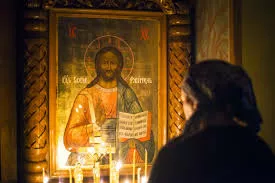
Today the Church celebrates the “Triumph of Orthodoxy”, which commemorates the victory over iconoclasm (a heresy of the eighth and ninth centuries that sought to suppress the holy icons and to forbid their veneration) and the restoration of the veneration of icons in Constantinople in 843. This Sunday, like the one that follows, strengthens the faithful in the Orthodox faith, as a condition for the fulfilment of the mystery of salvation. Indeed, the veneration of icons is an affirmation of the truth of the Incarnation of Christ and thus a confession of faith.
Divine Liturgy of St Basil:
Throughout Great Lent, on Sundays we celebrate the Divine Liturgy of St Basil (and not that of St John Chrysostom). The anaphora prayer of this Liturgy is a recapitulation of the whole mystery of salvation, accomplished in Christ.
9/3 – The 40 Martyrs of Sebaste
These valiant martyrs, who were Roman soldiers under the reign of Licinius (308-323), confessed Christ by refusing to sacrifice to idols, despite the horrible tortures to which they were subjected. They finally perished from the cold, having spent the night, naked and barefoot, on a frozen pond. At the moment of their death, soldiers present at the torment saw angels placing resplendent crowns on their foreheads. Thus, in joy and hope, they joined their beloved Lord and Master.
(Whatever the day of the week on which the feast of the Forty Martyrs falls, the Presanctified Liturgy is celebrated on it.)
Saturday of the second week: Saturday of the Departed
Throughout Great Lent, Saturdays are devoted to prayer for the departed. It is an essential rediscovery of the situation of “this world” as it is dying. But in Christ death has been destroyed from within; it has itself become the entrance into an abundance of life: for “death is no more”.
This commemoration prepares and announces the Saturday of the resurrection of Lazarus, and the Great and Holy Saturday, in which we see the fulfilment of the hope of resurrection that lies at the very depth of our faith. It is the light of these two celebrations that gives its full meaning to Christian death and to our prayer for the departed.
Sunday of St Gregory Palamas:
St Gregory Palamas, Archbishop of Thessalonica, defended Orthodoxy against an excessively rationalist and humanist conception of the spiritual life, which denied the possibility of deification and of participation in the divine life that are proper to a fully accomplished Christian life. By clarifying the distinction between the divine essence, inaccessible and unfathomable, and the uncreated energies, in which every Christian is called to participate, St Gregory restored to the mystical theology of Orthodoxy its full force. At the same time, he showed that the body itself is called to be transfigured by the divine glory, as Christ was on Tabor.
When, in the 14th century, the Church condemned the enemies of St Gregory and approved his teachings, this was acclaimed as a second triumph of Orthodoxy; this is why this celebration is placed in Lent, on the second Sunday.
Third Sunday: Sunday of the Veneration of the Precious Cross
We follow Jesus as He goes up to Jerusalem with His disciples. We already glimpse the end of our Lenten pilgrimage and the growing glimmers of Pascha.
During the first half of Lent, the Church invited us to concentrate our attention on ourselves, to struggle against the flesh and the passions, evil and all other sins.
From this Sunday on, it is the mystery of Christ’s suffering, of His cross and death that becomes the centre of the liturgical celebration of Lent. The veneration of the Cross at mid-Lent is a joyful participation in the victory of the Cross, which is celebrated not as an instrument of torture, but as the invincible trophy of Christ who by death has trampled down death.
At Matins of this day, the cross is carried in solemn procession to the centre of the church, where it will remain throughout the week and will be venerated at the services.
25/3 – Annunciation of the Most Holy Mother of God
“Today is the beginning of our salvation…”, sings the troparion of this day, one of the greatest feasts of the year. By saying “behold the handmaid of the Lord; be it unto me according to thy word”, the Virgin Mary redeems humanity from the disobedience of the Virgin Eve, and cooperates in the work of God by giving flesh to the new Adam. With the Angel Gabriel, we greet her who became more spacious than the heavens, since in her womb she bore the Creator.
Sunday of St John Climacus
The commemoration of St John Climacus, hegumen of the Monastery of Sinai and author of “The Ladder of Divine Ascent”, a veritable condensation of the whole Christian doctrine of the ascetic life and of the struggle against the passions, allows us to celebrate a model of asceticism and to be encouraged, by his example, to renew our efforts to obtain the crown of victory.
Sunday of St Mary ofEgypt
The commemoration of St Mary of Egypt allows us to celebrate a model of repentance, and shows us the power of tears to obtain forgiveness and reconciliation with God.
For an approach that helps to better understand the course of Lent and its meaning, you will find here the transcription of two talks on Radio Dialogue (the ecumenical radio of Marseille) by the Reverend Father Cyril Argenti: the course of Great Lent and the meaning of Great Lent.