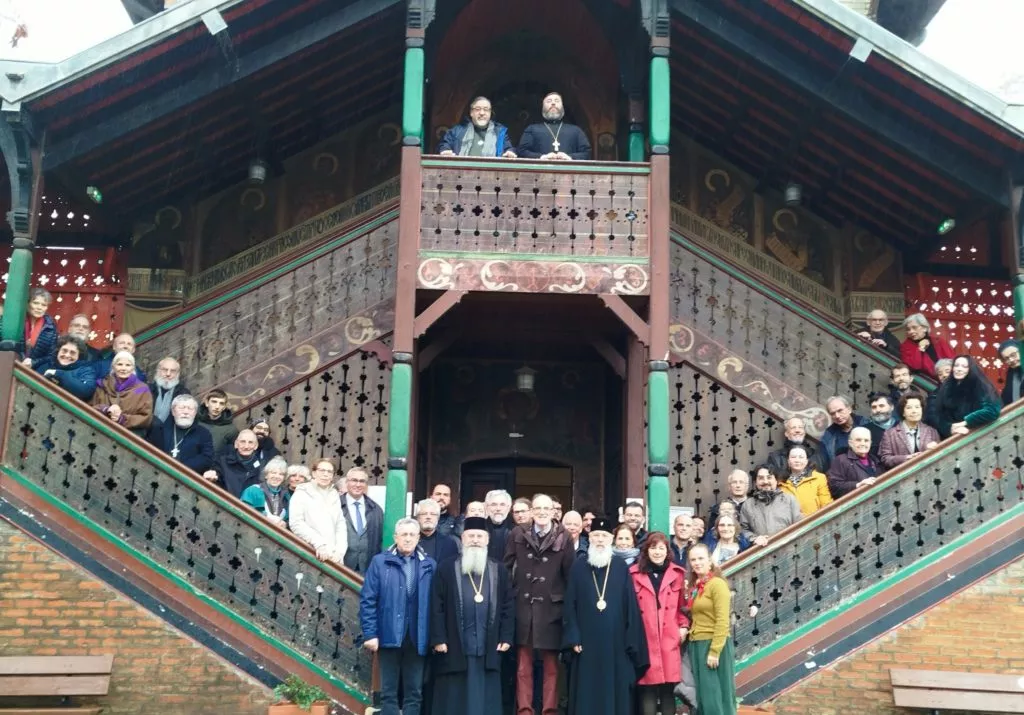
From 27 to 29 November 2025, the colloquium “Legacy and Horizons for Orthodox Theology in the 21st Century” was held in Paris, celebrating the centenary of the St Sergius Orthodox Theological Institute (ITO) with more than 150 participants (70 of them online). This international and ecumenical colloquium, which brought together 34 speakers over three days, set out to highlight the theological and spiritual renewal initiated by the ITO in the 20th century, while opening a reflection on the future prospects of Orthodox theology in the 21st century. While the first two days were devoted to a re-reading of the history of the Institute, to the testimonies of a few former students, and to the contributions of the ITO in the various theological fields, the last day was devoted to the integration of the ITO into the daily life of the Church and to witness in contemporary society.
On Thursday, 27 November at 1:15 p.m., the colloquium was opened by the words of welcome of Metropolitan John of Dubna, chancellor of the ITO, who expressed the hope that the meeting would not be limited to celebrating the past and the present but would open itself to the future, by continuing to spread Orthodox theology and to reflect with other Christian traditions on the new questions of post-modern society. The Dean of the ITO, Michel Stavrou, in his inaugural lecture entitled “The Miracle of St Sergius: A Century of Theological Work”, recalled the historical context in which the Institute appeared, then the spirit and development of its theological formation, the influence of the ITO within Orthodoxy and beyond, and finally its significant contribution to French society, in which it has been integrated for a century. “We have a duty,” he concluded, “to pursue our missions in the spirit of freedom and rigour bequeathed to us by our predecessors.”
The 1st session of the colloquium, entitled “The Great Stages of the Institute’s History”, offered an informed and concise re-reading of the century-long history of the ITO, structured in 3 periods: 1) “Foundation and First Decades of the Institute (1925–1945)” (Antoine Nivière), 2) “Expansion and International Opening of the Institute (1945–1976)” (Oleg Kobtzeff), and 3) “Anchoring of the Institute in Western Diversity and the Opening of the Iron Curtain (1976–2020)” (Cyrille Sollogoub). The 2nd session, devoted to a few outstanding figures in the history of the Institute, gave rise to a series of stimulating presentations: 1) “Fr Sergius Bulgakov, Georges Fedotov, Fr Basil Zenkovsky” (Daniel Struve), 2) “Mother Maria Skobtsova, Paul Evdokimov, Fr Nicolas Afanassieff” (Antoine Arjakovsky), 3) “Bishop Cassian (Bezobrazov), Fr Nicolas Koulomzine, Fr Alexis Kniazeff” (Fr Nicolas Cernokrak, Françoise Jeanlin), “Olivier Clément, Fr Nicolas Lossky, Fr Boris Bobrinskoy” (Bertrand Vergely). A service of thanksgiving was then celebrated in the church by the chaplain of the Institute, Fr Anatole Negruta, with the choir of the ACER, in the presence of Metropolitan Joseph (Romanian Metropolis of Western Europe) and Bishop Ignace (Patriarchate of Antioch). Then the Centenary exhibition of the Institute (with its 25 panels) was presented by Cyrille Sollogoub, vice-president of the ACER-MJO. The evening ended with a reception.
On Friday, 28 November in the morning, the 3rd session, “Receiving Sophiology and the Neo-Patristic Synthesis”, was devoted to revisiting the work of Fr Sergius Bulgakov (Michel Grabar, Barbara Hallensleben, Regula Zwahlen), and then to reflecting on the meaning of the rediscovery of the Fathers (Guillaume Bady, Stavros Yangazoglou). In the afternoon, the 4th session, “Some Contributions of the Theological Heritage to Be Transmitted”, offered summary presentations on liturgical theology (Fr André Lossky), ecclesiology (Joost van Rossum), canon law (Bishop Grigorios Papathomas) and ecumenical engagement (Julija Naett Vidovic). A presentation on “The Influence of St Sergius in America” (Alex Tudorie) closed the session. After the service of Vespers, a round table moderated by Oleg Kobtzeff made it possible to hear the rich and moving testimonies of Nathalie Schmemann, former administrator of the Institute, and of a few former students present: Bishop Seraphim (Joanta), currently Metropolitan of Germany, Mr Apostolos Apostolidis, Mr Sharif Bujanda, Fr André Kuzma, Fr Alexandre Sadkowski and Mrs Marie Stachowitsch. The evening ended with the preview screening of a new film about the Institute, directed by Fr Jivko Panev and Alexis Vozniuk.
On Saturday, 29 November, the morning was devoted to the 5th session on the future prospects of Orthodox theology in the 21st century. After a presentation of the “great contemporary challenges” (Pantelis Kalaitzidis), the following were addressed in turn: ecclesiological questions (Fr André Kuzma), the ethics of the post-modern subject (Fr Basil Thermos), ecological challenges (Elizabeth Theokritoff) and the missionary breath (Thanassis Papathanassiou). In the afternoon, two round tables were to address the engagement of the Institute.
The first round table, “The St Sergius ITO and the Life of the Orthodox Church in France”, moderated by Julija Naett Vidovic, brought together Metropolitan John of Dubna, Bishop Marc (Alric), Fr Marc Génin, Fr Emmanuel Lomuller, Georgiana Huian and Michel Stavrou. Four priority orientations were identified for the future: 1) to develop a training programme for catechists in partnership with the AEOF; 2) to set up a cycle of continuing education for clergy and parish leaders; 3) to create a course devoted to new modes of communication applied to Orthodox theology and spirituality; 4) to establish a liaison committee between the Orthodox theological institutes of Western Europe and the AEOF, aimed at coordinating pastoral priorities and training offerings.
The second round table, “Training New Generations of Theologians”, moderated by Sophie Stavrou, brought together Matthieu Sollogoub (ACER-MJO), Nicolas Tirrier (Nepsis-France), Stavros Yangazoglou (University of Athens), Nicolas Cochand (IPT) and Anne-Sophie Vivier-Muresan (ICP). To introduce young people to theology and give them an appetite for it, a few avenues were proposed: 1) to help restore the value of these studies in the eyes of society, 2) to integrate theology into multidisciplinary curricula, 3) to multiply the modes and places of training, while leaving time for a slow spiritual maturation.
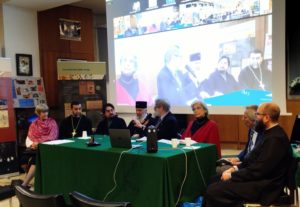
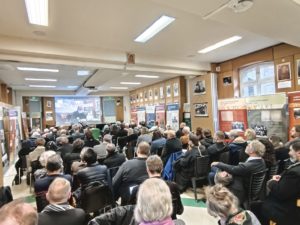
To close these three days of a colloquium marked by the joy of encounters, the sharing of a revisited common memory and a forward-looking reflection on the future of Orthodox theology, Dean Michel Stavrou invited all to inaugurate the second century of the history of the St Sergius Institute with gratitude, humility and hope. The Proceedings of the colloquium will be published in the Institute’s new electronic journal, which will be launched in 2026.